Guide
Bagni San Filippo Hot Springs: The White Whale in the Tuscan Woods
In winter, you see the steam before you see the stream. It hangs low among the trees, and as you make your way down the path a milky ribbon of water comes into view, slipping over steps of startlingly white limestone. This is Bagni San Filippo, and the hottest water running past your feet leaves the spring at 48 degrees.1
If you’re staying in Cortona, this is the most effortless spa day you’ll find. Set off in the morning, soak in pools tucked into the woods, stop for lunch on the drive back and be home before dark. To get the most out of it, you’ll want to know where to leave the car, which pool to pick and what rules apply around the Balena Bianca, the White Whale, the limestone cascade that put this corner of Tuscany on the map.
Where is Bagni San Filippo?
Bagni San Filippo is a tiny village in the municipality of Castiglione d’Orcia, in the province of Siena. It sits 524 metres above sea level,2 in the band of woodland where the Val d’Orcia starts climbing towards Monte Amiata. Its thermal waters have been known since ancient times, and they still run free down a stream through the trees.1
The setting is a rare one. Around 9 kilometres away rises the volcanic cone of Amiata, and 4 kilometres away is the protected area of the Crete dell’Orcia e del Formone.3 Pienza, a UNESCO site thanks to its town plan, is about 16 kilometres off.4 The whole Val d’Orcia has been on the World Heritage List since 2004, recognised as a farming landscape that still follows its Renaissance design.5
That’s the whole case for going if you’re based in Cortona. In one day you get to soak in hot water under the open sky, walk through quiet woods and drive the hills of the Val d’Orcia, all without changing hotels.
Cortona to Bagni San Filippo: a day on the road
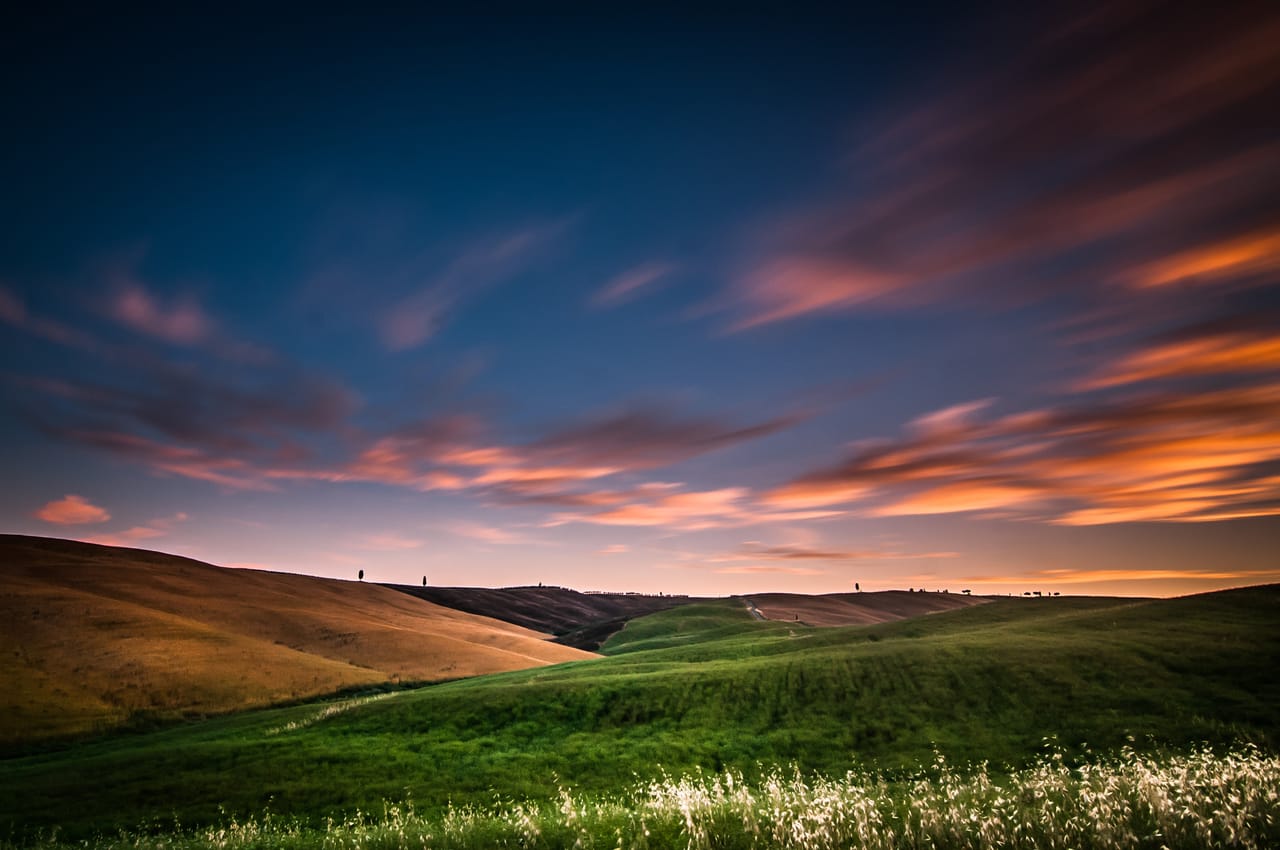
You’ll need a car, and the easy part starts before you’ve even set off. Pull out of the hotel’s private car park in your own time, ideally after a coffee on the terrace, and within a short while you’ve left the Valdichiana behind for the Sienese countryside.
There are two ways to go, and it’s worth doing both: one out, the other back. The first heads down towards Chiusi and Sarteano, then climbs to Radicofani on hairpin bends that open up a fresh view of Amiata at every turn. The second runs through Montepulciano, Pienza and San Quirico d’Orcia, across the rolling fields and cypress rows you’ll recognise from a hundred postcards.
A well-paced day looks roughly like this:
- early morning: reach the Fosso Bianco and get your first soak in before the crowds;
- late morning: wander round the village and stop at the Grotto of San Filippo Benizi;
- lunch: somewhere on the drive back, in one of the Val d’Orcia villages;
- afternoon: Pienza, 16 kilometres away, with low light falling across the clay hills;
- evening: back to Cortona for a shower and dinner.
If a day at the hot springs appeals but you fancy a different feel, keep Bagno Vignoni and Rapolano in mind for another day of your stay.
The Fosso Bianco and its hot pools
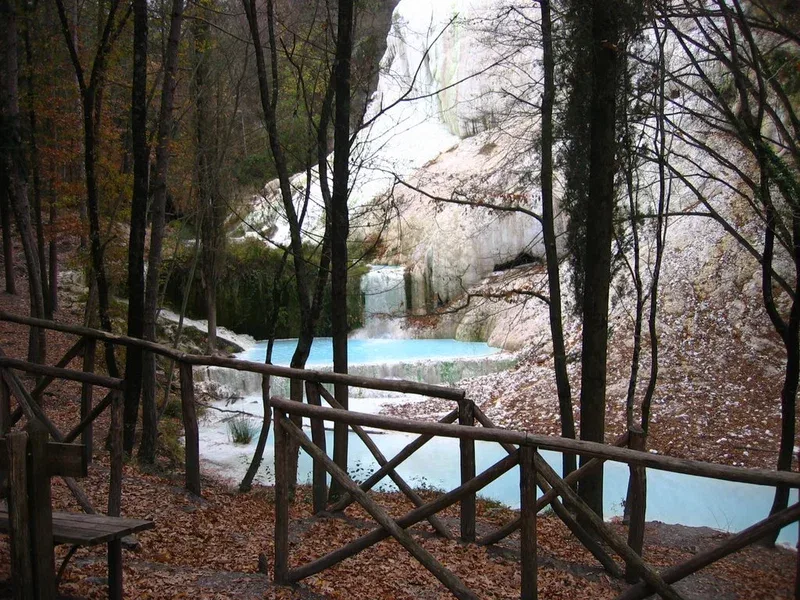
The way in is easy to miss. As you enter the village, a gravel track drops away on the left to the Fosso Bianco, a woodland stream fed by several hot springs. The local council describes it as a string of pools, proper natural swimming baths, and you can only reach it on foot.6
Along the way you’ll pass limestone formations that visitors have named after their shapes, such as the white whale and the glacier.6 The scenery never stays quite the same. The flow and course of the water shift often, especially in winter when rain mixes with the thermal water, and the colours, from white to pale blue, depend on the spring. Thermal mud settles on the bottom of the pools, the same mud people have been using on their faces and bodies for centuries.1
How to pick your pool
One rule of thumb works well. The closer you are to the spring, the hotter the water, and it cools as the stream runs downhill. Walk for a few minutes and dip a hand in before you climb in.
| Stretch of stream | What the water is like | Best for |
|---|---|---|
| Near the Balena Bianca | The hottest, up to 48 °C at the spring | Looking only: bathing next to the formation is banned |
| Middle pools | Hot, and pleasant even in the colder months | A long winter soak |
| Lower pools | Warm, sometimes cool | Hot days, and anyone who wilts in the heat |
In winter, head upstream to the hottest pools and keep your distance from the cascade. At the height of summer, a lukewarm pool further down is often the nicest option, and usually the quietest too.
The Balena Bianca: a waterfall to admire
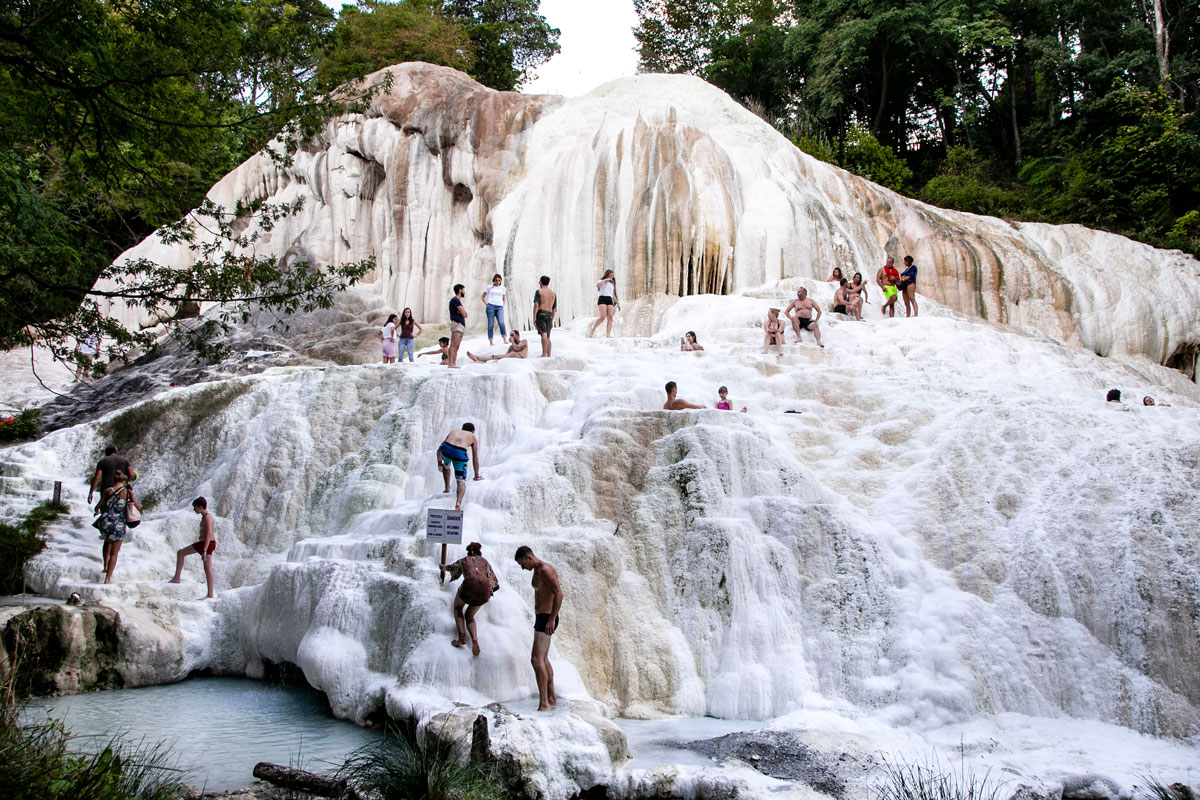
You can’t miss it. The white rock stands out against the dark green of the woods so sharply it looks almost unreal. The Balena Bianca is a huge mass of limestone built up over time from the sediment in the thermal water, and it takes its name from its resemblance to a whale’s open mouth.1
It’s also the most fragile spot on the whole Fosso Bianco. The formation is delicate, and touching it, walking on it or bathing near it is forbidden. There are plenty of pools to sink into in peace just a little further on.1
Fosso Bianco ground rules
- Don’t touch the Balena Bianca or climb on it.
- Don’t bathe next to the cascade.
- Respect any tape, fencing and signs you find on site.
- Take everything home with you, rubbish included.
- Keep your voice down: the hush of the woods is part of the place.
Take your time looking at it, photograph it at leisure, then make your way down to the pools. For many visitors, the moment that stays with them is that first glimpse from the top of the path.
Where do you park, and what does it cost?
Bathing in the Fosso Bianco pools is free, as they’re open-access thermal pools in a natural setting.1
For parking and any charges, check with the Comune di Castiglione d’Orcia before you set off or read the signs when you arrive, and bring a few coins and a card just in case.
Timing makes a big difference. On sunny weekends the spaces closest to the path fill up fast. Get there early, or go on a weekday. You’ll find a space without driving in circles and have the stream almost to yourself.
When to go, season by season
The water stays warm all year round, warm enough for a dip even out of season.1 What changes is the light, the number of people and the temperature of the air.
| Season | What you’ll find | Our tip |
|---|---|---|
| Winter | Steam over the woods, rain mixed into the water, paths that shift | Seek out the hottest pools and bring warm clothes for getting out |
| Spring | Green woods, mild air, few people on weekdays | The best all-round time for a first visit |
| Summer | Lots of visitors, especially at weekends | Arrive early and go for the cooler pools further down |
| Autumn | Warm colours in the woods, hot water, crisp air | Great midweek too, with the afternoon in Pienza |
If you can, pick a weekday outside the summer months. You’ll be lying back in a hot pool with the sound of the stream and not much else.
What to pack
The pools are in the middle of the woods, so there’s none of what you’d expect from a spa. Pack your bag in Cortona:
- an old swimsuit, as the sulphurous water can stain fabric;
- water shoes, handy on the slippery bottom and the limestone edges;
- a large towel or a bathrobe, plus a hat for getting out in winter;
- a waterproof bag for your wet swimsuit;
- drinking water, because hot water dehydrates you more than you’d think;
- a bag for your rubbish, to take home with you;
- nothing made of glass.
A little extra care saves you nasty surprises. The bottom of the pools is smooth and slippery, so move slowly. Near the springs the water is very hot, so it’s best to alternate short soaks with a few minutes out. Keep a closer eye than usual on small children.
The village, the Medici and the Grotto of San Filippo Benizi
After your soak, give the village half an hour. The waters of Bagni San Filippo were known in ancient times.1 Cosimo I de’ Medici had the baths restored in 1566.6
The church in the centre of the village was built with stones from the old Gothic church of San Filippo. That earlier church stood at the top of the village and was abandoned because of the damp from the nearby sulphur springs. Inside are three stucco statues of St Philip Neri, St Philip the Apostle and St Philip Benizi.6
On the road that winds down from Campiglia d’Orcia to the village is the Grotto of San Filippo Benizi. Tradition has it that the Servite friar hid here in 1269, after the death of Pope Clement IV, to avoid being elected pope. The grotto is carved into a great block of limestone and still draws pilgrims today.6 Legend says the thermal waters first sprang from this very spot.1 After the woods and the steam, it’s the right place for a few minutes of silence.
Back to Cortona
The drive home is part of the outing too. If you came via Chiusi, head back through Pienza and Montepulciano and cross the Val d’Orcia between the cypresses in the late-afternoon light.
Back at the hotel, you leave the car in the private car park, your skin still soft from the thermal water. A long shower, a glass in the garden, then out to the terrace as evening settles over the Valdichiana. After a day like that you’ll sleep early, and tomorrow there’s another of the day trips around Cortona to choose from.
Sources
Footnotes
-
Bagni San Filippo — dati (Wikidata). wikidata.org ↩
-
Aree protette vicino a Bagni San Filippo. wikidata.org ↩
-
Patrimoni UNESCO vicino a Bagni San Filippo. whc.unesco.org ↩
-
UNESCO World Heritage. whc.unesco.org ↩
-
Comune di Castiglione d’Orcia. comune.castiglionedorcia.siena.it ↩ ↩2 ↩3 ↩4 ↩5