Guide
Cortona Weather Season by Season
The Cortona forecast on your weather app is a townwide average, and when you’re staying in the historic centre it only tells you half the story. Cortona sits at 494 metres above sea level, with the Girifalco Fortress higher still, while Camucia and the train station stay down on the floor of the Valdichiana, noticeably lower.1 That gap in elevation is what decides how hard August heat hits you, whether you’ll want a jacket in May, and why the hilltop breathes easy in the evening while the valley below still swelters. Here’s the weather season by season, with the practical logic to work out what to expect and what to pack.
Cortona’s climate at a glance
Cortona has a Tuscan hill climate: mild in the shoulder seasons, with a big swing between day and night thanks to the altitude. Rain clusters in autumn and spring, summer runs hot and dry with the odd afternoon heat storm, and winter is cold with overnight frosts and a dusting of snow on the higher ground. In the shoulder seasons the light turns soft and the temperatures are just right for walking uphill.
| Season | What you’ll get | Rain | What to pack |
|---|---|---|---|
| Spring (Mar–May) | Mild days that keep warming, cool mornings, sharp day/night swings | Frequent, often brief | Light layers, a windbreaker, a folding umbrella, comfortable shoes |
| Summer (Jun–Aug) | Hot and dry, fierce afternoon sun, cool hilltop evenings | Rare, the occasional heat storm | Light clothing, a hat, sunglasses, a sweatshirt for the evening |
| Autumn (Sep–Nov) | Warm and bright early on, damp and wet toward November | Frequent, especially late season | A raincoat, a jumper, shoes with grip for wet ground |
| Winter (Dec–Feb) | Dry cold, overnight frosts, clear sun on fine days | Less frequent, snow possible up high | A winter coat, a scarf, gloves, warm non-slip footwear |
Three-day forecasts change everything once your dates are set, and for those the services you already check will do the job. The handy apps for getting around Cortona include the local forecasts, from 3B Meteo to the Air Force bulletin. This page is for the step before that, while you’re still choosing when to come.
The 494 metres that shape your day
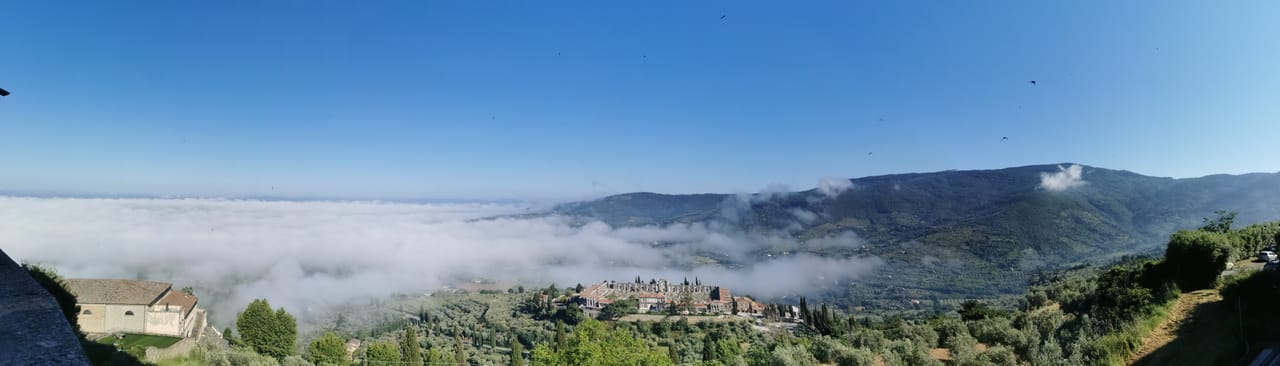
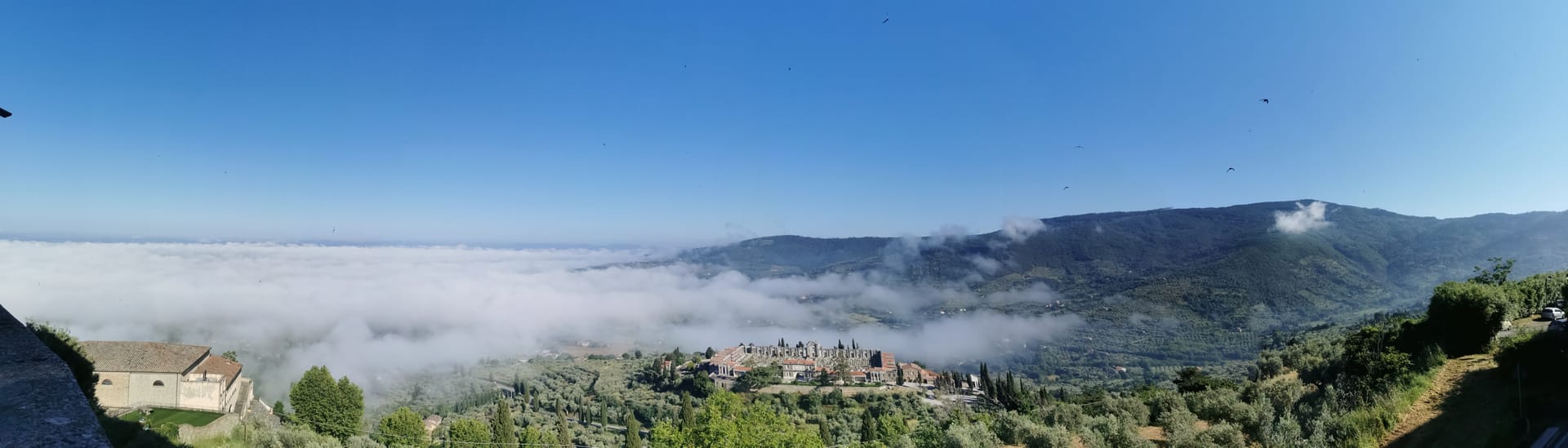
Here’s the detail no bulletin spells out. The forecast that carries the name “Cortona” is calculated across the whole municipal territory, a broad area that climbs from the valley floor up to the ridges. The historic centre where you’ll be walking, and where the Hotel Villa Santa Margherita stands, sits at 494 metres, an elevation that shaves a few degrees off summer evenings and brings a breeze you simply don’t feel down in the Valdichiana.1
Put plainly: when the app posts a high temperature for Cortona, that reading is calibrated to the valley. Up on the hill, as the first evening shadows fall, the temperature drops sooner and the breeze makes an outdoor dinner comfortable while Camucia is still stifling. It works the other way in winter too, when the overnight frosts bite harder at altitude and the shaded cobbles stay iced over until mid-morning. Keep it in mind when you pack and when you plan your outings.
Spring in Cortona: full colour and a changeable sky
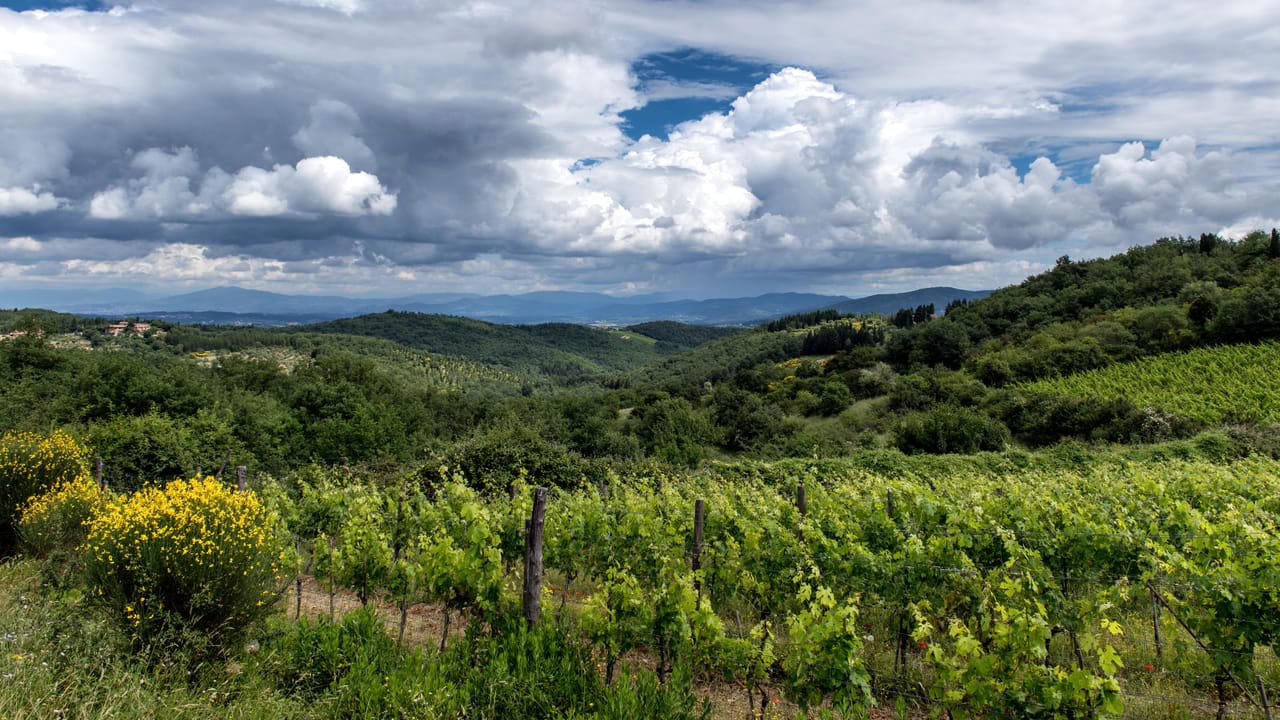
Spring in Cortona has a lot going for it, and for good reason. From mid-March the countryside lights up, olive trees and poppies pattern the hills, and the days stretch out with temperatures that beg you to walk. The catch is how quickly it changes. In April you can get a crystal-clear morning and an afternoon storm, with a real temperature gap between the moment you set out and the moment you’re back at the hotel.
The rule here is dress in layers. A T-shirt under a light shirt under a windbreaker covers nearly every scenario, and a folding umbrella in your bag takes care of the rest. May is often the sweet spot, with settled days and green everywhere, ideal for walks out to the Le Celle Hermitage or your first rides among the olive groves. If you love the outdoors, the protected areas around the town are at their best right now, from Monte Ginezzo seven kilometres out to the Lake Trasimeno belt at eighteen.2
Summer in Cortona: the heat, the shade of the alleys, and evenings on the hill
Cortona’s summer is hot and dry, and it’s best enjoyed by following the rhythm of the sun. The historic centre is all uphill and paved in stone, so on the hottest days the afternoon is for keeping cool. Early morning and evening are your windows for the streets of the centre, while the middle of the day calls for the MAEC, the Cathedral, the workshops, and a slow lunch in the shade.
This is where the altitude works in your favour. Once the sun sets the hill cools fast, and a stroll along the Parterre with the Valdichiana spread out below becomes the finest moment of the day. Always bring a hat, water and sunglasses, but tuck a light sweatshirt into your bag too, because evenings at 494 metres ask for something over your shoulders even in August. Anyone travelling with a dog will especially appreciate the early-morning walks, a point that matters a great deal in summer and speaks directly to anyone after a dog-friendly Cortona.
Autumn in Cortona: the best light and the first rains
From mid-September Cortona moves into its most photogenic season. The heat melts away, the light turns golden, the harvest fills the hills, and temperatures stay gentle for weeks. It’s the stretch I’d recommend to anyone who wants to walk without battling the sun and eat well without the high-season crush, among Chianina beef, mushrooms and the first new oil.
Toward late October and into November the picture shifts and heavier rain arrives. These aren’t wasted days, because museums, churches and wine bars make Cortona’s autumn just as rich indoors. The thing to watch is the sloping stone paving, which turns slippery when wet, so the sole of your shoe counts for more than the umbrella. A light raincoat and footwear that grips damp flagstones will see you through most surprises.
Winter in Cortona: dry cold, silence and clear days
Winter is the season of silence, and in Cortona it has a charm all its own. Clear days deliver a sharp sun and pin-sharp views over the valley, with the cold, dry air that comes with the hills. The nights are biting, and the snow, when it comes, mostly settles on the higher ground, the Girifalco and the ridges.
You’ll want a winter coat, a scarf and gloves, and above all warm footwear with good grip, because early in the morning the shaded paving can be iced over. In return you get a town drawn in on itself, quiet restaurants, and the kind of stillness that suits a visit to the places of the spirit. Anyone with mobility needs should factor the ice into the climbs, an aspect tied to accessibility in Cortona that weighs more heavily in the cold months than elsewhere.
From the weather reading to the travel decision
The real question is what you do with that number, more than the degrees themselves. Weather shapes travel choices far more than it seems, and it’s one of the factors steering where and when people decide to go.3 In Cortona the translation is concrete, and it almost always comes down to the climb.
Strong heat pushes your visits to the centre into the early morning and the evening, leaving the afternoon for places indoors or in the shade. Rain doesn’t cancel the day, it redraws it toward the museums and the workshops, with the one caveat of slippery stone. Dry cold is perfect for long walks, as long as you wrap up well. If you want to line up the weather with the practical shape of your days, the practical guide to visiting Cortona works through visit times and how to split your stay along the route, while here we’re working through the weather you’ll actually find.
Which season for which trip
If you’re after countryside in bloom and walks without the swelter, aim for late spring. If you want long evenings, life outdoors and the local festivals, summer gives you all of it, provided you manage the heat with the right hours. If you love golden light, good food and the colours of the harvest, September and October are your window. And if what you want is silence, clear views and a town all to yourself, Cortona in winter rewards anyone who doesn’t mind the cold.
Fonti
Footnotes
-
Cortona — dati (Wikidata). wikidata.org ↩ ↩2
-
Aree protette vicino a Cortona. wikidata.org ↩
-
Tourism and Climate Change: Impacts, Adaptation and Mitigation. books.google.co.id ↩