Guide
Shopping in Cortona: A Guide to Authentic Artisan Finds
Shopping in Cortona has nothing to do with the racks of mass-produced souvenirs you find in every hill town from here to the coast. Craft is still a working trade here, kept alive in the workshops of the old centre, where a leather bag, a ceramic plate or a bottle of Syrah comes straight from the hands of the person who signs it. Think of this guide to shopping and craftsmanship in Cortona as a considered map rather than a list of shop windows: a way to get your bearings among the kinds of genuine buys worth making, so you know what to look for and where before you ever cross a threshold.
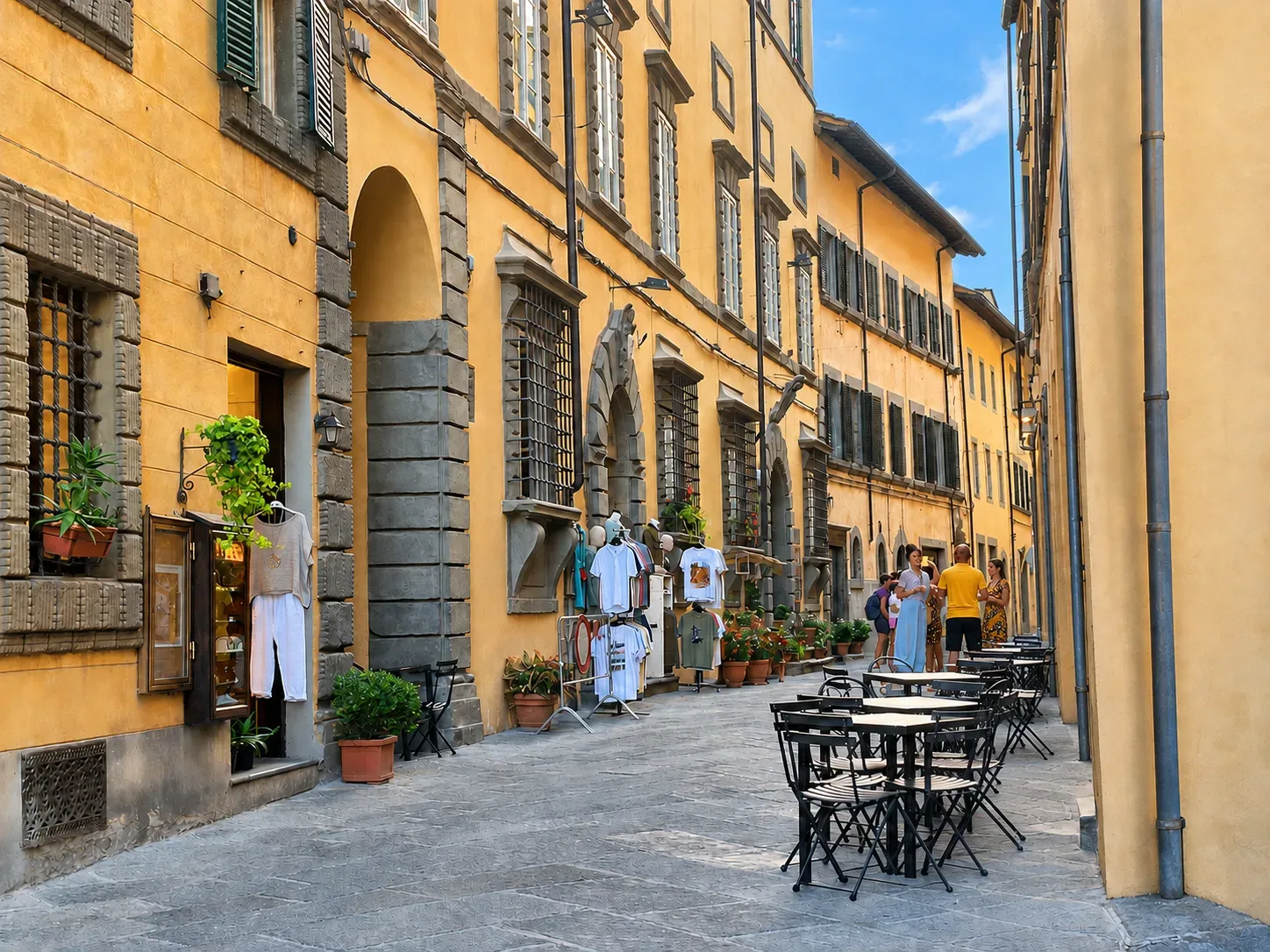
Cortona is one of those Tuscan towns where commerce and history share the same streets. Its narrow lanes, climbing between squares and ancient walls, hide an artisan workshop around almost every corner 1. Treat this article as a front door, because each thread opens onto a piece of its own — so you can choose at your own pace, in the spirit of slow travel.
Buying in Cortona is an experience, not just a purchase
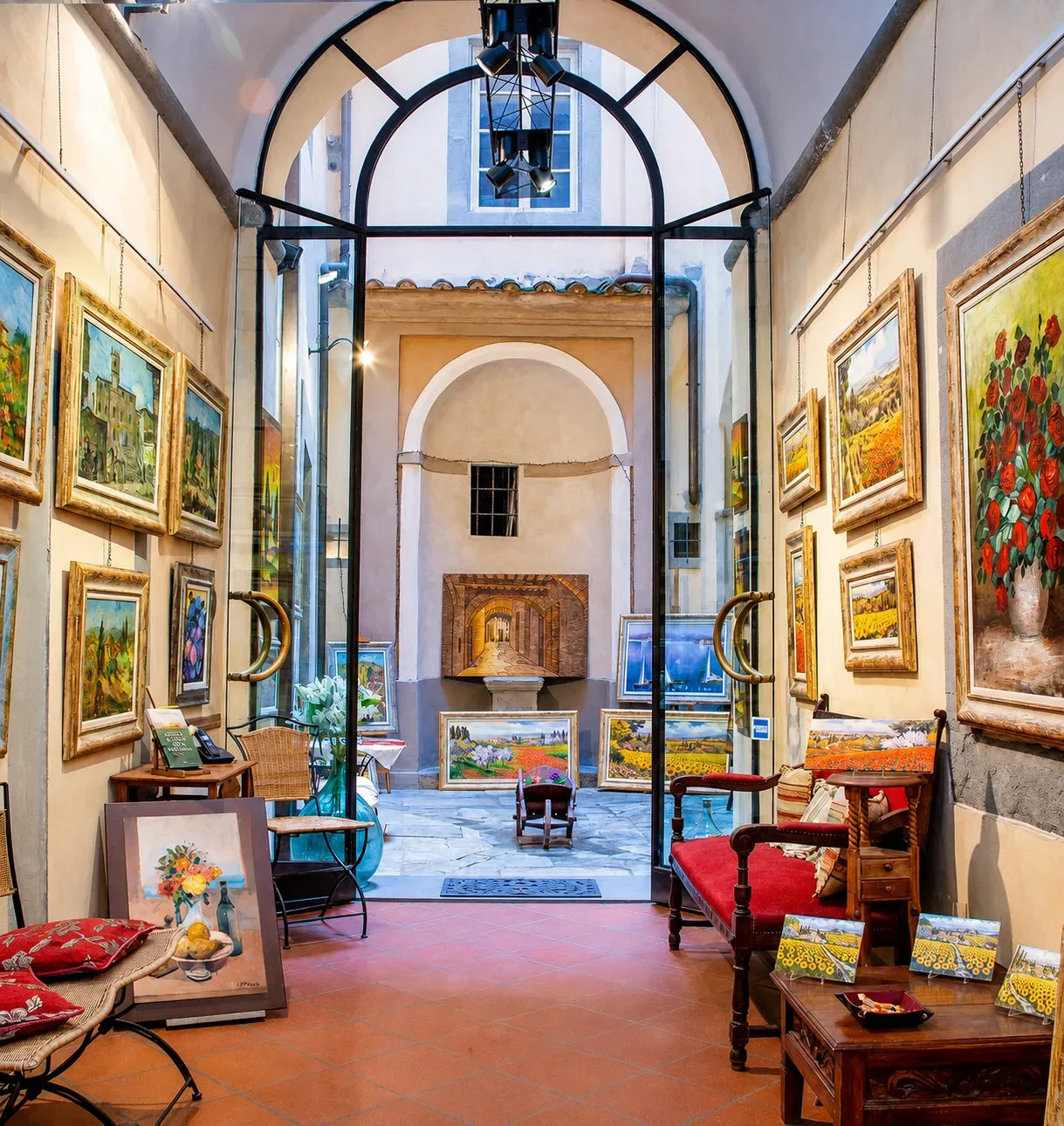
In Cortona’s old centre, local craft and commerce blend into one another: clothing and hats, shoes, handmade leather bags, one-off ceramics, olive-wood objects, jewellery and genuine works of art 2. What sets it apart from a chain comes down to exactly this — workshops run by families, and techniques handed down from one generation to the next, which is what makes every piece impossible to repeat.
Buying here means taking home a fragment of the place itself. Academic research on tourism confirms that perceived value has a direct bearing on how travellers decide to buy souvenirs 3. The more authentic and rare an object, the more it becomes a memory of the trip rather than just a thing.
What are the typical things to buy in Cortona? The five genuine specialities are hand-painted ceramics in the tradition of Cortona’s cocci, handmade leather goods, olive-wood objects, Syrah DOC Cortona wine and local extra-virgin olive oil. Add to these the niche food products — pecorino cheeses, cantucci and Vin Santo.
Traditional craft and Cortona’s know-how
At the heart of genuine shopping in Cortona is craft — meaning the hand skill that carries across the decades. This is the thread of know-how, the thing that tells a workshop apart from an ordinary shop. Here are its main forms, each with a piece of its own to explore.
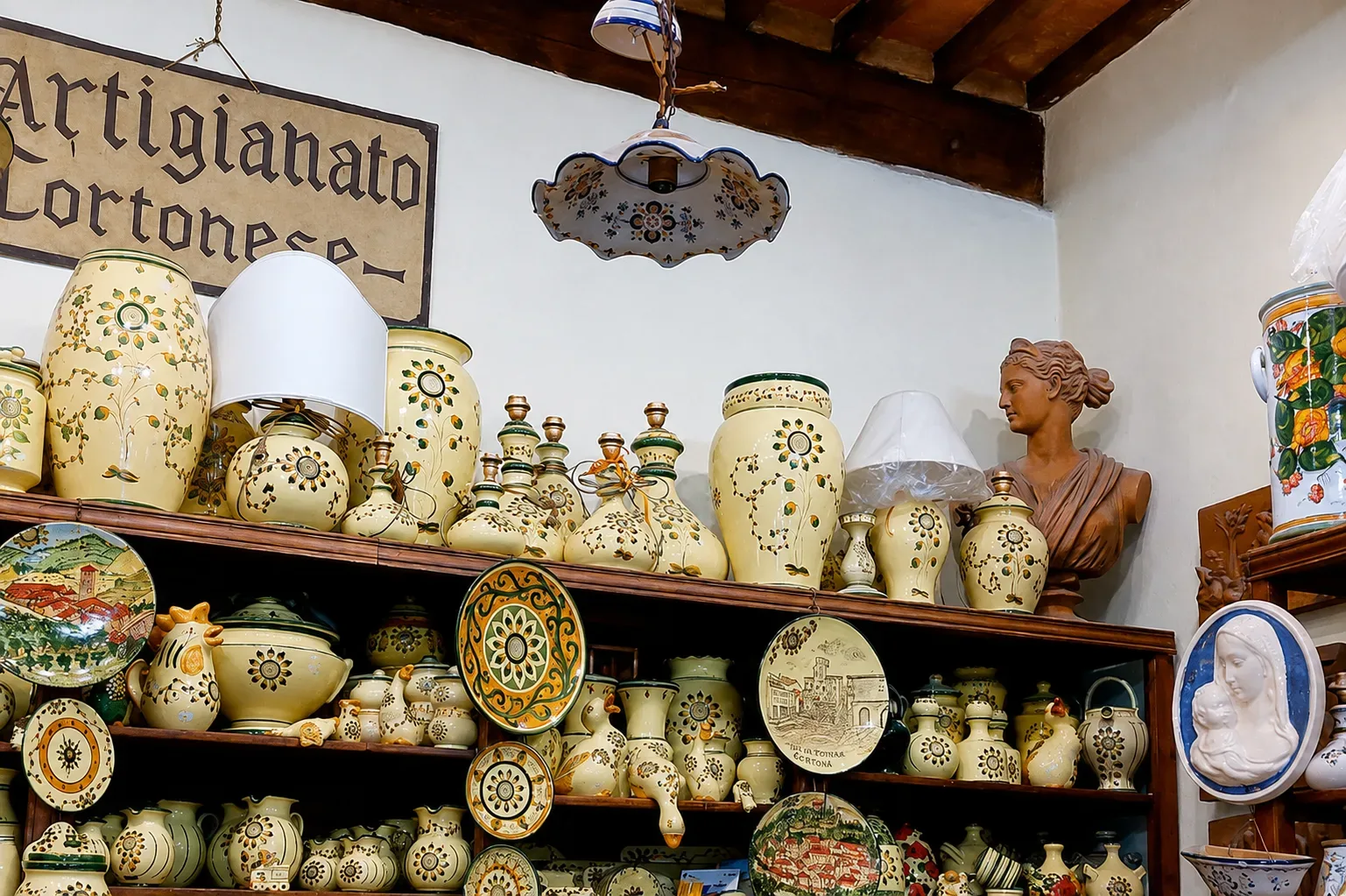
- Ceramics. Cortona’s cocci, hand-painted using the ingobbio slip technique, paint the Tuscan landscape onto plates, coloured glasses and small objects 2. It is the oldest craft of all, with roots reaching back to the Etruscans. Everything about Cortona’s handmade ceramics.
- Woodwork. Cortona still keeps its historic cabinet-making workshops. The Rossi Woodworkers workshop, founded in the early 1900s by Armando Rossi, has passed through generations while perfecting the making of furniture 2; in 2014 Giancarlo carried the tradition forward 2. Discover woodcraft in Cortona.
- Leather and hides. Tuscany has worked leather since the Middle Ages 4, and in Cortona that craft tradition is still going strong: the old centre has workshops specialising in handmade leather bags and accessories, often in limited runs, where every piece comes from techniques handed down over time.
- Wrought iron. A lesser-known but living craft, found even in the cabinet-making workshops that broadened their skills to metal 2. See wrought iron in Tuscany.
- Workshops you can visit. Several open their doors to anyone who wants to watch the work up close. All of Cortona’s artisan workshops.
Tuscan scents, cosmetics and fragrances
There is a slow kind of luxury, made of essences and fragrances, that fits perfectly with the idea of a genuine buy. In Cortona this thread finds its fullest expression in the Officina Profumo-Farmaceutica di Santa Maria Novella, one of the oldest and most prestigious names in Italian perfumery, heir to a herbal and pharmaceutical tradition that reaches back centuries. It is no accident that its famous Pot-pourri is chosen to scent the rooms of the Hotel Villa Santa Margherita — a sign of how thoroughly this house stands for quiet elegance and a sense of place.
Alongside that historic name, Cortona has a scent all its own: Essenza di Cortona, born from the work of Cortona pharmacist Antonio Aimi together with the master perfumers of Grasse, made in a small cosmetics laboratory in the old centre 5. The line takes in men’s and women’s fragrances and room scents inspired by the surrounding countryside, such as Fico Olivo and Vigna Rossa 5.
Art, antiques and collectors’ pieces
Cortona has been a city of art for millennia — one of the twelve lucumonie of the Etruscan League 6 — and that cultural standing shows in its shop windows. Beside the trade workshops lies a second world, that of collecting and art objects, which deserves to be kept apart from the gift shops.
- Antiques. For enthusiasts, Cortona keeps a standing date right in the centre: on the fourth Sunday of every month, Piazza Signorelli fills up with “Ritorno al passato”, a market of antiques and vintage finds, its stalls piled with collectors’ pieces, period objects and curiosities to hunt down. Then, at the end of summer, the town becomes the stage for Cortonantiquaria, Italy’s oldest antiques fair: between late August and early September, the historic halls of the Sant’Agostino Convention Centre host a top-tier selection of dealers, among paintings, sculptures, silver, furniture and period furnishings. Anyone wanting more can push on to Arezzo, where the first Sunday of each month brings the far larger Fiera Antiquaria, one of the most important antiques markets in Italy 7. Antiques in Cortona.
- Art workshops and galleries. Spaces showing original work, prints and paintings with views of the Tuscan landscape 2. Cortona’s art galleries.
- Frames and period prints. A niche buy for anyone who loves taking home an old image of the land. See the antique prints.
- Handmade jewellery. Tuscany has a long goldsmithing tradition, with Arezzo nicknamed the “city of gold” for its workshops 4. Cortona’s handmade jewellery.
- Fine textiles. From embroidery to cloth, the region guards its old weaving arts 4. Tuscan textiles.
Paper, books and historic bookbinding
There is one thread almost no guide bothers with, which is exactly why it counts double for anyone after something rare. The historic stationers and binderies still keep the art of handmade paper, bound notebooks and prints alive, in an age when everything has gone digital. A quiet buy, perfect for anyone who loves to read and write. Discover the world of bookbinding in Cortona.
Flavours to take home: wine, oil and local specialities
A good part of shopping in Cortona is done by taste. The land offers food and wine of real quality that makes for perfect gifts, to enjoy on your return or to give away.
- Wine shops and enoteche. Syrah DOC Cortona takes the lead, but the Tuscan wine list runs deep, with 11 DOCG, 41 DOC and 6 IGT wines 4. Many estates nearby offer visits with a tasting down in the cellar 1. Cortona’s wine shops.
- Niche food products. Extra-virgin olive oil, pecorino cheeses, DOP and IGP cured meats, chestnut flour, right through to cantucci and Vin Santo 4. The typical food products.
- Weekly market. Every Saturday from 7am to 1pm the market spreads between Piazza Signorelli and Piazza Franciolini 2. Everything about Cortona’s weekly market.
What food and drink should you buy in Cortona? The most genuine choices are Syrah DOC Cortona wine, local extra-virgin olive oil, the area’s pecorino cheeses and cured meats, and cantucci with a glass of Vin Santo. Add to these the pici, the fresh hand-rolled pasta that is the emblem of Cortona’s farmhouse cooking — also sold dried, ideal to take home and cook with a chianina beef ragù or with aglione, the big, mellow-tasting Valdichiana garlic that is another symbol of the area (often sold ready as a sauce). For anyone wanting a genuine piece of the Valdichiana to bring home, the local butchers have excellent chianina cuts and cured meats — ask for them vacuum-packed for the journey. Don’t miss the local truffle either, fresh or turned into creams and pastes, and the honey from the surrounding hills. These are all typical Cortona products that travel easily and make the perfect edible gift.
Bulky buys? Boutiques and outlets nearby
Alongside the craft, the old centre has fashion boutiques with designer clothing, signed hats and elegant accessories 2. For anyone chasing the big labels, the area is well served by outlets. Valdichiana Village, just 25 minutes from Cortona, gathers more than 120 international and Italian brands 2. See Cortona’s fashion and boutiques and the guide to outlets nearby.
Bulky purchases? How to handle international shipping
It happens often, especially to those who have come a long way. You fall for a piece of antique furniture, a large ceramic set, or you want to take home a case of wine — and it won’t fit in the suitcase. It’s a real problem that almost nobody explains. There is a solution, between specialist couriers and workshops that arrange home delivery, even across borders. You’ll find the practical steps for shipping your purchases, so you can buy without a second thought about getting it home.
Where to shop in Cortona, among its lanes and squares
Finding your way is easy, because the centre is compact and pedestrian. Arriving from the car parks, you walk up Via Nazionale, the main shopping street, which climbs gently to Piazza della Repubblica, the heart of the town, looking onto historic buildings like the Palazzo Comunale 8. From here, staying more or less on the same level, you reach Piazza Signorelli, where the Saturday market sets up 2
Where are the shops in Cortona? The workshops are concentrated along Via Nazionale and around Piazza della Repubblica and Piazza Signorelli, all within the pedestrian old centre. You cover it comfortably on foot, moving from one category to the next in a few minutes.
Precisely because Cortona is a town to discover slowly and on foot, having a comfortable base makes all the difference. The Hotel Villa Santa Margherita sits a short walk from the old centre and has its own private car park. You leave the car at the hotel and reach the pedestrian zone without the stress of the ZTL, enjoying the shopping at the slow pace it deserves.
Fonti
Footnotes
-
Scoprire Cortona, un gioiello senza tempo. tenutedelcerro.it ↩ ↩2
-
Shopping in centro storico di Cortona | I negozi e gli artigiani.. cortonamia.com ↩ ↩2 ↩3 ↩4 ↩5 ↩6 ↩7 ↩8 ↩9 ↩10
-
A Model for Perceived Destination Value and Tourists’ … digitalcommons.georgiasouthern.edu ↩
-
Profumo di Cortona | Essenza di Cortona. essenzadicortona.it ↩ ↩2
-
Cortona — Wikivoyage. en.wikivoyage.org ↩
-
Breve guida all’artigianato artistico della Maremma. visittuscany.com ↩
-
10 cose da fare a Cortona. visittuscany.com ↩