Every year, on the second weekend of June, Cortona travels six centuries back in time with the Giostra dell'Archidado, one of Tuscany's most beloved historical reenactments and one of the region's officially recognized historic events.
Edition 2027
Main weekend dates: Thursday-Sunday of the second weekend of June 2027
Medieval market and related activities: in the days and weekends before, usually starting late May
Location: historic center of Cortona, Piazza SignorelliEdition number 32
The history of the Giostra: a wedding that changed Cortona
It all began in 1397, when Cortona celebrated the wedding of Francesco Casali, lord of the city, and Antonia Salimbeni, a noblewoman from Siena. According to the chronicle reported by Girolamo Mancini in his work "Cortona nel Medioevo" (in the chapter dedicated to the wedding of Francesco Casali and Antonia Salimbeni), the bride arrived in Cortona on January 8, 1397, accompanied by the groom and by Uguccio. Nobles and representatives from across the region attended the celebrations: from Florence, from Città di Castello, Niccolò Castracani with an escort of ten horses, Ottaviano Ubaldini with his wife and twenty horses, the lord of Baschi and other nobles with their own retinues, along with trumpeters, pipers, musicians and fencers. The Malatesta of Rimini, the castellans of Castiglione Aretino and of Isola Maggiore, and the lords of Lake Trasimeno also sent gifts for the occasion.
To honor the newlyweds, all the city's quintieri competed against each other in a crossbow tournament: from that moment on, the Giostra dell'Archidado became part of Cortona's memory and identity. After centuries of being forgotten, the reenactment was revived in 1994 and has been held every year since, with the whole city dressing up in medieval style.
The five quintieri of Cortona
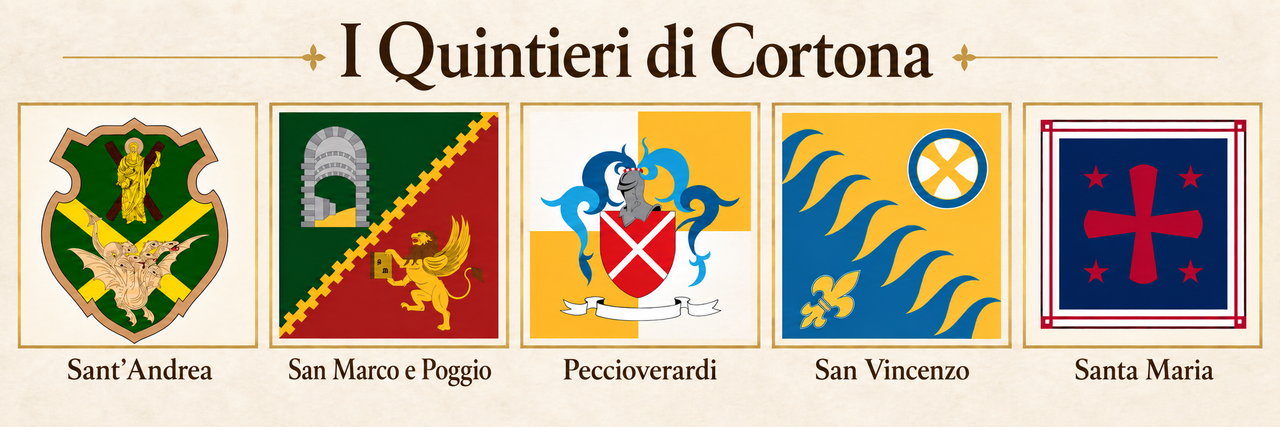
Cortona has historically been divided into five quintieri, the districts that have structured the city's social and civic identity since the Middle Ages: Sant'Andrea, San Marco e Poggio, Peccioverardi, San Vincenzo and Santa Maria. Each quintiere is represented in the Giostra by two crossbowmen, and the rivalry between the districts is felt with the same pride that must have driven the people of Cortona six centuries ago. During the event, each quintiere sets up its own decorations, colors and tavern, turning the alleys of the historic center into as many small medieval kingdoms.
How the Giostra weekend unfolds
The event unfolds over an entire weekend, following a structure that traditionally repeats every year:
Thursday opens with the Palio della Civetta, an archery competition involving archers and enthusiasts of historical shooting.
Friday is the turn of the Serata delle Bandiere (Evening of the Flags), when the Gruppo Sbandieratori e Musici della Città di Cortona, together with guest groups from other historic towns, performs flag-throwing displays and medieval music in Piazza Signorelli.
Saturday brings the historical reenactment of the wedding procession of Francesco Casali and Antonia Salimbeni, with hundreds of costumed performers parading through the streets of the center, recreating the atmosphere of the 1397 wedding.
Sunday afternoon, traditionally at 4:00 PM, hosts the actual competition: the Giostra dell'Archidado.
The rules of the crossbow tournament
On the Saturday before the tournament, the Tratta delle Verrette takes place, the draw that determines the shooting order of the crossbowmen from the five quintieri. Sunday morning is dedicated to the "provaccia," a general rehearsal before the official contest in the afternoon.
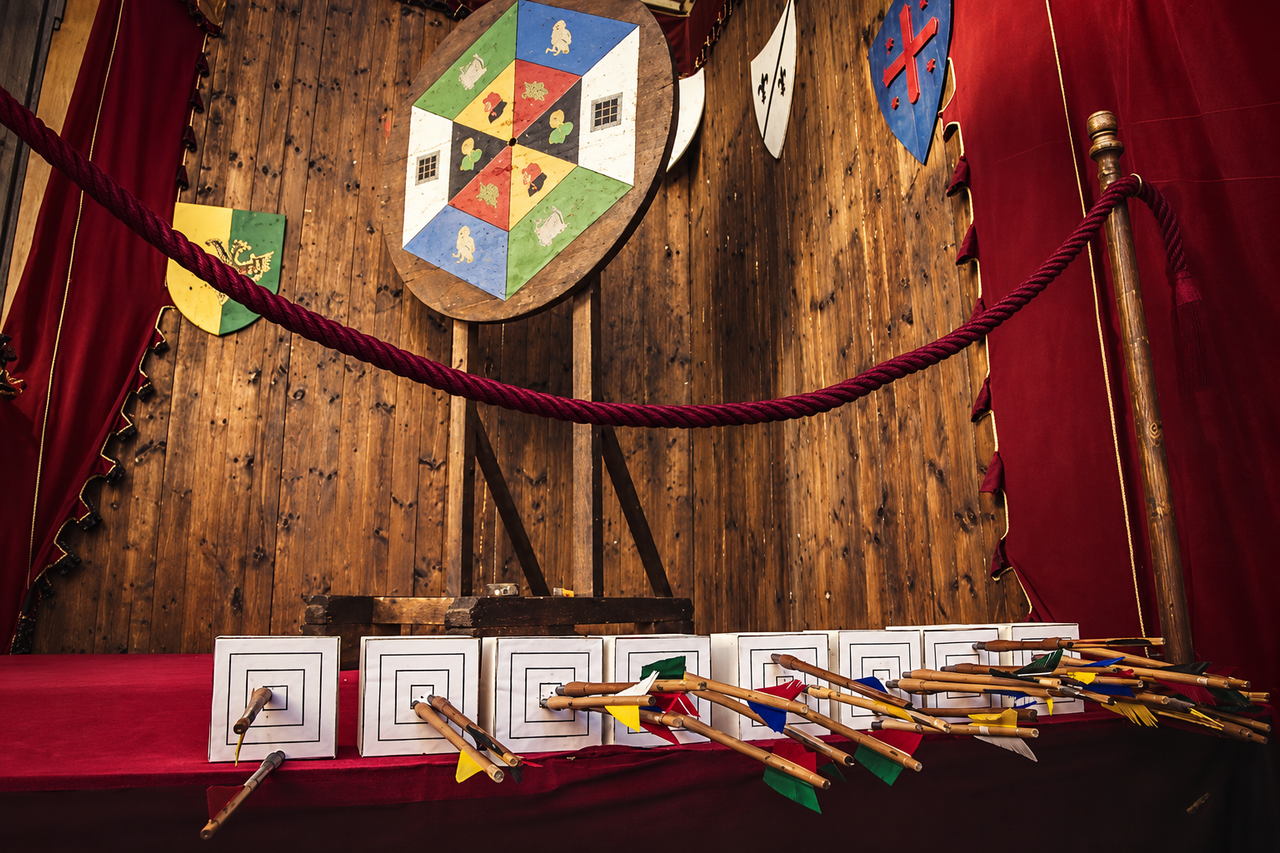
The target is placed about 20 meters away and consists of a die-shaped design at the center of a wooden panel: four concentric sections award a score from 1 to 5 points, while six other sections around the die, in different colors, cause points to be lost if hit. Each crossbowman has two minutes to take aim and shoot. The rules are strict and allow no exceptions: the scores from both rounds of shooting by all the crossbowmen are added up, and the quintiere with the highest total wins the trophy, the Verretta d'Oro (Golden Bolt), to be proudly kept until the following edition.
The medieval market and the Taverna del Balestriere
In the days leading up to and accompanying the Giostra, Piazza Signorelli and the historic center come alive with a medieval-style market: scenes of everyday life from the era, jesters, falconers and archers entertain visitors among the stalls. For those who want to experience the atmosphere at the table too, the Taverna del Balestriere (Crossbowman's Tavern) offers dishes and flavors inspired by medieval cuisine, in an informal, convivial setting that completes the Medieval Week experience.
Why the Giostra matters to Cortona
The Giostra dell'Archidado is not just a show for visitors: it's an occasion of shared identity for the people of Cortona, who every year put on their quintiere's colors with the same pride felt six centuries ago. It is among the historical reenactments officially listed among Tuscany's historic events, and represents one of the rare cases where a documented medieval chronicle (that of Girolamo Mancini) still translates today into a living festival, deeply felt and shared by an entire community.
Where to stay for the Giostra dell'Archidado
Villa Santa Margherita is 5 minutes from the historic center of Cortona, the ideal base for experiencing the whole Medieval Week and Giostra weekend without giving up comfort. Discover our rooms and current offers.