Guide
The Way of St Francis in Cortona: Last Tuscan Stop Before Assisi
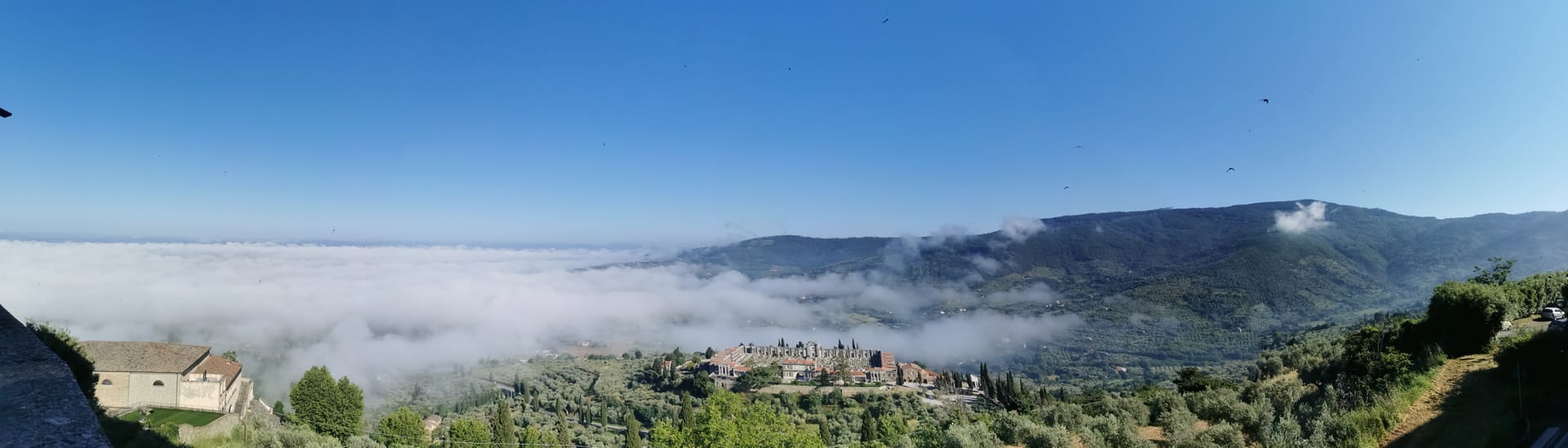
You feel the arrival at Cortona in your legs, on that last climb, when the medieval walls surface above the olive groves and the 494 metres of altitude that lift the town above the floor of the Valdichiana finally register. Cortona is the last Tuscan stop on the Way of St Francis before the route crosses the border and heads on toward Umbria and Assisi. The pilgrimage takes on real weight here, because the first hermitage the Poverello ever wanted, Le Celle, sits a few minutes from the centre, tucked into a cleft of Monte Sant’Egidio.
This page is written from the arrival town’s side of the story, for anyone who wants to know where the stage genuinely ends, what ties Francis to this place, and how the walk carries on toward Lake Trasimeno. Cortona sits at the meeting point of many historic trails; here we stay with the Way of St Francis.
One route, three different names
Look this walk up and you will keep running into three names, as though they were three separate routes. They are the same path.
- Via di Francesco, the historic name of the itinerary linking La Verna and Assisi, the one used across Italy’s walking-route portals.
- Via di Francesco in Toscana, the regional name for the route, whose Anghiari-to-Cortona section runs 69.90 km across 3 stages rated as hiking-grade difficulty. 1
- Cammino di Francesco, the national route promoted by the Ministry of Tourism and listed on italia.it, crossing six regions (Abruzzo, Lazio, Marche, Umbria, Emilia-Romagna and Tuscany). Within that framework Cortona is stage 2.C, Pieve di Rigutino – Cortona, given fresh prominence during the celebrations marking 800 years since the saint’s death. 2 3
Hold onto that one equivalence and every guidebook falls into place. Type “cammino di san francesco cortona” or search “via di francesco toscana” and you are looking at the same trail through two different doors.
Why Francis came to Cortona
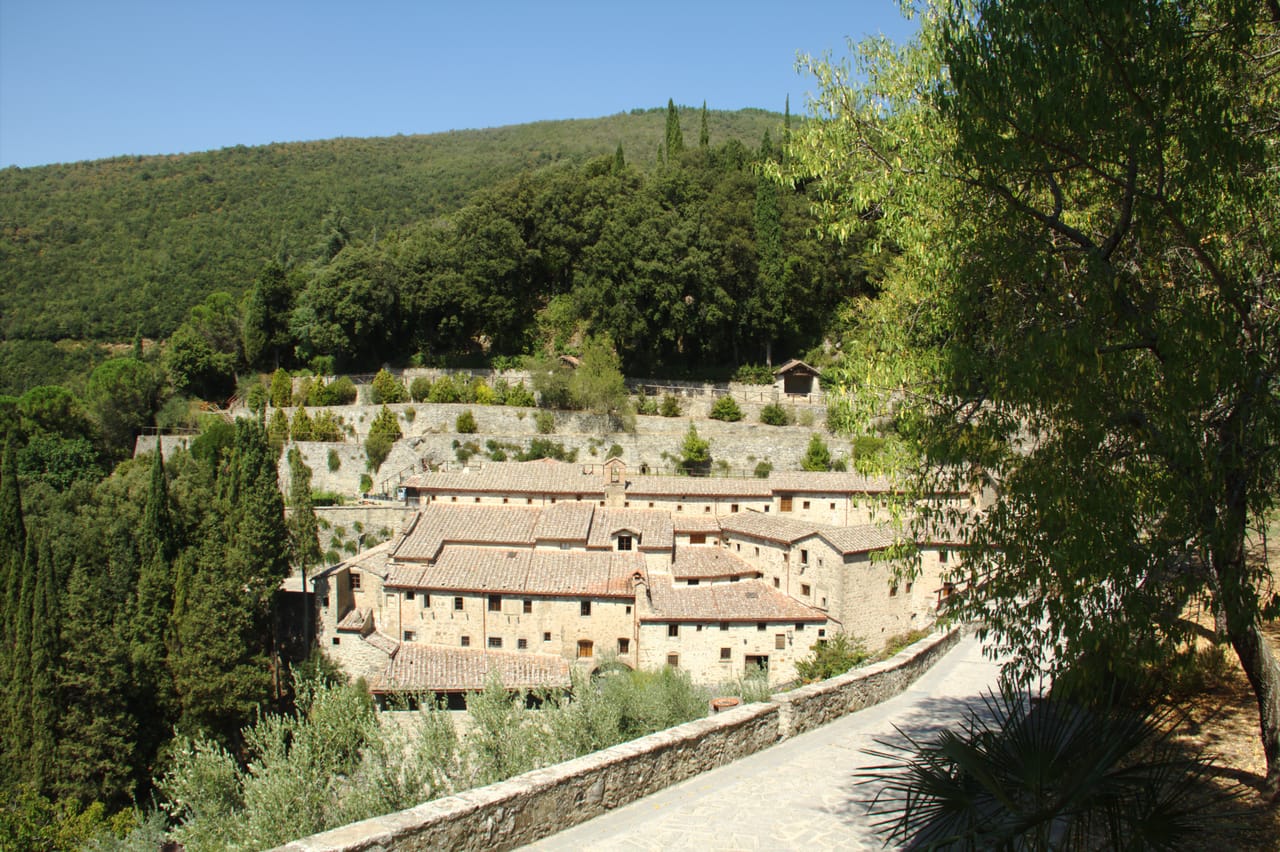
It began with a visit in 1211. Francis came to preach near Cortona and, as he so often did, asked for a secluded spot where he could withdraw to pray. A young nobleman of the town, Guido Vagnottelli, offered him a rough, uninhabited hollow on Monte Sant’Egidio, where water ran and the rock split into a fissure. That gift gave rise to the Le Celle hermitage, one of the first Franciscan settlements Francis chose and wanted for himself. 4 5
The bond only deepened over the years. In 1215 Francis returned to Le Celle for Easter, having spent Lent alone on Isola Maggiore in Lake Trasimeno. His last stay in Cortona came in 1226, the year of his death on 3 October. Tradition holds that here at Le Celle, in the twilight of his life, he may have dictated his testament. 4 3
After the saint’s death a native of Cortona takes the stage. Brother Elias, born in Assisi in 1178 and dead in Cortona in 1253, minister general of the Order of Friars Minor, remembered the place where Francis had loved to sit in silence. A gifted builder, in 1235 he began the first section of the sanctuary, raising in stone the Cell and the Oratory of St Francis and, above them, a small refectory with five little cells no bigger than the saint’s own. 4
There is a third Franciscan thread that belongs to Cortona alone. Margaret of Cortona (Laviano 1247 – Cortona 1297) received her first visions and her conversations with the Crucifix in the town’s church of San Francesco, and became a Franciscan tertiary. The Basilica of Santa Margherita, built in the 14th century on Monte Egidio beside the old church of San Basilio where the saint lived and died, crowns Cortona with a wide view over the Valdichiana. 5
The stage that ends at Cortona
The Tuscan section that carries pilgrims here sets out from Anghiari and passes through some of the loveliest corners of the Valdichiana Aretina. The route runs through Arezzo, where the Basilica of San Francesco holds Piero della Francesca’s fresco cycle of the Legend of the True Cross, then drops down to Castiglion Fiorentino, a town crowned by its Cassero and ringed by all-but-intact medieval walls, and skirts the imposing Castle of Montecchio Vesponi. 1
Near the end of the walk you reach the Pieve di Sassaia, dedicated to Saints Quiricus and Julitta, an 11th-century building that now houses a pilgrims’ hostel. From there the final leg leads to the Le Celle hermitage and on into town. Here are the essential figures for the section, useful for gauging the effort before you set off:
- The route runs from Anghiari to Cortona 1
- It is split into 3 stages 1
- It measures 69.90 km in total 1
- Every stage is rated hiking-grade difficulty 1
- You arrive in Cortona at 494 m above sea level 6
The stage brushes the lower slopes of Monte Sant’Egidio without climbing to the summit, which stays the domain of the Croce di Sant’Egidio and the ridge paths. The surface alternates between gravel tracks and stretches of tarmac, and in the heat of a summer afternoon that last climb toward the walls makes itself felt. To walk it without the fierce heat, timing and safety matter a great deal. As a rule, spring and early autumn stay the kindest windows.
The Franciscan sites to see once you are in town
Arrival completes the walk. Cortona keeps the marks of Francis’s passing within a short stroll inside the walls, and it is worth setting aside half a day for them before you move on.
The church of San Francesco, founded by Brother Elias in 1245, is the urban heart of this story, the place where Margaret had her first visions. The Basilica of Santa Margherita, at the top of Monte Egidio, repays the climb with a sweeping view over the Valdichiana plain, closed off on the horizon by the mountains of Siena, by Amiata, Cetona and the sheet of Lake Trasimeno. 5
And then there is the Le Celle hermitage, wrapped in the silence of the woods on the edge of town, where the cell in which the saint stayed is still preserved. What happened here is what counts, and Le Celle deserves an unhurried visit; one of the walking paths up to Le Celle climbs to the hermitage straight from the centre.
Setting off again toward Trasimeno and Assisi
Anyone who wants to press on from Cortona toward Assisi finds the way already marked by the pilgrims of centuries past, descending into Umbria.
The final goal is closer than it looks. Assisi, with its Basilica of St Francis on the UNESCO World Heritage list, lies about 56 km from Cortona as the crow flies. 7 Cortona is a crossroads of walks. The Via Lauretana branches off here too, and the Via Romea Germanica passes through.
If you would rather sample the walk than take on the whole itinerary, the last Tuscan leg works beautifully as a one-day route with a clear point to it: the arrival inside the walls and the pause at Le Celle. Sleeping in silence the night before you set out changes the rhythm of the walk, and Hotel Villa Santa Margherita, a few steps from the old town and close to the climb up to the basilica, offers exactly the quiet and the on-site parking that a walker with a pack is looking for.
How long is the stage that ends at Cortona?
The Tuscan section from Anghiari to Cortona measures 69.90 km and is split into 3 stages of hiking-grade difficulty. The final leg brings pilgrims into town by way of Castiglion Fiorentino, the Castle of Montecchio Vesponi and the Le Celle hermitage. 1
Can you walk just part of the route?
Yes. Plenty of casual walkers pick the last Tuscan leg as a one- or two-day outing, arriving in Cortona with a stop at Le Celle, without taking on the whole itinerary from La Verna. It is the ideal formula for anyone travelling as a couple or a family who wants a day’s walk with a spiritual meaning, followed by a quiet base to settle into.
What really ties St Francis to Cortona?
In 1211 Francis preached near Cortona and received from Guido Vagnottelli the spot where the Le Celle hermitage rose, one of the first friaries he asked for. He returned more than once, up to his final stay in 1226, the year of his death. The bond carries on through Brother Elias, a Cortonese by adoption who built the sanctuary, and through St Margaret, a Franciscan tertiary. 4 5
How do you carry on from Cortona to Assisi?
From Cortona you continue into Umbria as far as Assisi, the town of St Francis, about 56 km away. 7
Where do I find maps and route tracks?
The official details for stage 2.C are published on the Ministry of Tourism’s italia.it portal. 3 On the ground, there are also trail maps available at the hotel.
Fonti
Footnotes
-
Da Anghiari a Cortona. laviadifrancescointoscana.it ↩ ↩2 ↩3 ↩4 ↩5 ↩6 ↩7
-
Cammino di Francesco: guida completa e itinerari - Italia.it. italia.it ↩
-
Qui la tappa del Cammino di Francesco. L’iniziativa del Ministero del Turismo. comune.cortona.ar.it ↩ ↩2 ↩3
-
La Storia. lecelledicortona.it ↩ ↩2 ↩3 ↩4
-
Cortona Francescana. cortonaeventi.it ↩ ↩2 ↩3 ↩4
-
Cortona — dati (Wikidata). wikidata.org ↩
-
Patrimoni UNESCO vicino a Cortona. whc.unesco.org ↩ ↩2